
Whinney
Hill East
This website is here to help you explore and improve Hyndburn’s woodlands and wild spaces.
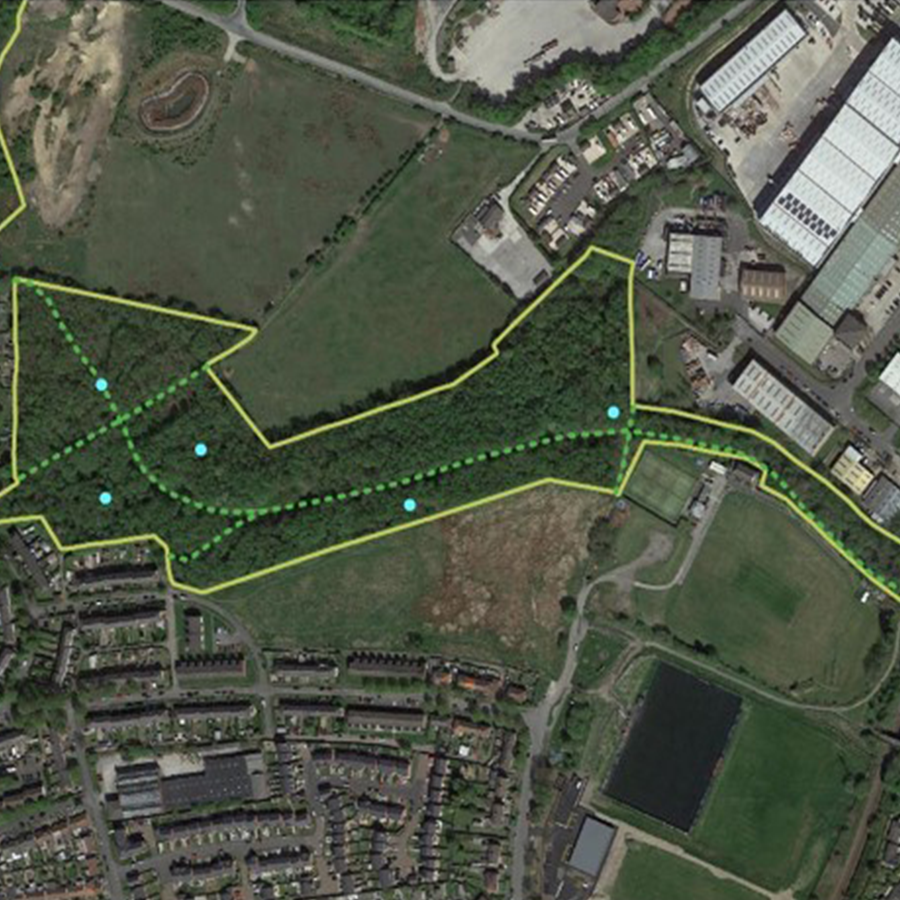
Flat land associated with the former brick-shale quarry / waste tip reclaimed and planted by Lancashire County Council in 1987 and 1989. A large urban broadleaf woodland with good footpath access and intense public usage. Crossed by many public footpaths. Preponderance of willow and alder. Much potential for community involvement and habitat development. PROSPECTS’ involvement to date with grant funded management and improvement has been very positive and demonstrates what can be achieved in one year with volunteer effort.
Location: Main access points on Livingstone Road and Thorneyholme Road, Accrington
Grid Reference: SD 7617 2991
What3Words: buddy.impose.perky
Nearest Postcode: BB5 5BW
Size of site: 8.61 hectares
Initial Planting Year: 1987
Age: 35 years
Download the Whinney Hill Condition Report.
Species of Trees and Shrubs recorded on Site: Hawthorn, Wild Cherry, Hazel, Holly, Birch, Willow, Alder, Ash, Blackthorn, Dogwood, Sycamore, Rowan, oak, Aspen, Bird Cherry, Field Maple, Whitebeam, Spindle, Guelder Rose, Grey Poplar
Species of Plants recorded on Site: Sedge, Japanese Knotweed, Himalayan Balsam, Bramble, Bryophytes, Nettle, Willowherb species, soft rush, Wood Avens, Ground Elder, Creeping buttercup, Field Horsetail, Bindweed, Male-Fern, Creeping Cinquefoil, Ribwort Plantain
Tufted Hair Grass, Yorkshire Fog
Species of Birds observed on site: tawny owls, tree sparrow, wren, blackbird, robin, carrion crow, great tit, blue tit, pied wagtail, dunnock, wood pigeon,
These two sites were formerly associated with the Accrington Brick and Tile Works. The land on which the previous works stood was acquired by LCC from George Armitage & Son, previous owners of the company. It was reclaimed in 1987/1989.
Local History
In May 1825 Whinney Hill was used as the site of a mass gathering of hand loom weavers protesting about new machinery putting them out of business. The weavers marched to Accrington to smash up weaving machinery.
Geology
Red fireclay known as Accrington Mudstone or shale was deposited in the area during the Carboniferous period when the Accrington area was flooded by a large lake. Fireclay is found close to coal seams.
Local Industry
The area had many collieries and textile mills. From 1887 world famous Accrington bricks (NORI) were produced at Whinney Hill. The local fireclay was iron hard and was used to produce strong engineering bricks that were acid resistant. It is a general belief that the name NORI was derived from IRON spelled backwards. The clay was quarried at Whinney Hill up until the 1960s. These special acid resistant bricks could be used for lining flues and chimneys. They have been used in the construction of some iconic buildings such as Blackpool Tower, the Empire State Building in New York, Sellafield Nuclear Power Station and Battersea Power Station.
The brick works had its own mineral railway line connecting with the East Lancashire line at Huncoat and was close to the Leeds/Liverpool canal, allowing easy transportation of goods countrywide.